

Visiting Assistant Professor in Environmental Analysis at Pitzer College
Interdisciplinary social scientist, using critical GIS and community mapping to reveal the links between place and health through a Just! GIS.
Guillermo Douglass-Jaimes, PhD
Check out my recent publications:
Douglass-Jaimes, G. (2025). Just! Geographies: Orienting Our Pedagogies Toward the Social and Ecological Justice Horizon. The Professional Geographer, 1–7. https://doi.org/10.1080/00330124.2025.2502494
Abstract
As geographers, we might ask “Where is justice located?” If we knew, we could plot our course. Yet, much like Eduardo Galeano envisioned utopia sitting on the horizon, constantly receding as we move toward it, justice is a destination we might not reach. Rather than find despair, how can we orient our work toward the horizon of social and ecological justice? Specifically, how can geographers, who have long engaged with notions of justice, do so in the classroom? How can pedagogical interventions help us engage with the complex spatial and temporal dimensions of justice, which are shaped by processes across all scales from the macro (global systems of oppression) to the micro (interpersonal and internalized oppressions) and all the messy entanglements in between? I use Just! (Just factorial) as a visible signal of our efforts to move together, building on the work of those who came before us as we respond to our present moment. Efforts in the classroom can recognize the larger oppressive forces at play and seek to build within the spheres of our control to create what I call a fractal of justice, one that is bounded within the limits of the classroom, while recognizing that our abilities to move toward a more expansive and inclusive justice are vast when we work together.
Douglass-Jaimes, G., Keeve, C., & Ybarra, M. (2025). Reorienting Knowledge Production Through Storytelling and Collaborative Practice. The Professional Geographer, 1–7. https://doi.org/10.1080/00330124.2025.2512095
Abstract
Human geographers have long engaged in place-based research, and a growing number of scholars have grappled with the contradictions that arise in upholding our place-based values. This Focus section highlights challenges for geographers engaging in community-based work, focusing on power relations in ways of knowing within and beyond academic knowledge production. These interventions in earth writing take shape through accountable methodologies led by storytelling and collaborative practice; a turn in the discipline that we situate alongside imaginative, insurgent scholarship in Indigenous, Black, Latinx, and feminist geographies. In this introduction, we highlight three themes: cultivating webs of accountable relationships through kin-making and community struggle; navigating the precarity and systemic violence of academia for collaborative relationships, as well as marginalized scholars, particularly for those of us not contemplated in historically White universities and colleges; and how these, in turn, open up possibilities for multivocality and multitemporality in single-authored scholarship, allowing for the ambivalences of collaborators’ voices, refusals, and silences to resonate through the research papers. We end with a call for geographers to engage in practice with and beyond the framework of scholar-activism and community-based research.
Prado, Carolina, and Guillermo Douglass-Jaimes. 2025. Surveying Community Environmental Justice: Urban Runoff Patterns in Eastern Tijuana, México. Soc. Sci. https://www.mdpi.com/2076-0760/14/2/63
Abstract
In an urban region of eastern Tijuana, there are long-standing water runoff sites which community members have identified as having an impact on residents, including contributing to flooding. This community-based participatory research (CBPR) project in collaboration with the Colectivo Salud y Justicia Ambiental (CSJA) used the geospatial surveying tool Survey 123 to conduct community-based monitoring of five runoff sites. Results from 170 completed surveys showed that water runoff was present at these sites on forty-five percent of the days surveyed, although there was no significant relationship between the temporal factors studied and the water quality characteristics surveyed. These findings contribute to the field of border environmental justice by focusing on the understudied issues of runoff and urban flooding as environmental exposures that some communities experience disproportionately. Moreover, while there was a significant relationship between water runoff volume and precipitation events at the water runoff sites, there were sixty-five surveys collected that showed water present when there had been no precipitation event at the site. This finding supports the CSJA members’ assertions that the runoff experienced in the study area is not always connected to precipitation events or pluvial flooding. This project’s results contribute to policy advocacy by countering the policy narrative that this issue is simply a stormwater issue, and by identifying the specific runoff sites to be prioritized in this region.
Keywords:
environmental justice; urban surface runoff; urban flooding; community-based water monitoring
Latinx Geographies Collective, Cahuas, M. C., Douglass-Jaimes, G., Faiver-Serna, C., González Mendoza, Y., Martinez-Lugo, D., & Ramírez, M. M. (2023). Latinx Geographies: Opening Conversations. ACME: An International Journal for Critical Geographies, 22(6), 1462–1489. Retrieved from https://acme-journal.org/index.php/acme/article/view/2286
Abstract
With increased interest in Latinx geographies there is a need for more in-depth exploration of how Latinx geographers are approaching this work in their own words. In this article, we open a discussion on Latinx geographies that is grounded in our multiple, different, embodied experiences as Latinx geographers who have gathered over the last several years to have conversations, create spaces and build relationships of care and accountability with each other. We reflect on how we each arrived to Latinx geographies, what it means to us, how we do Latinx geographies and what is on the horizon. We refuse singular or imposed definitions, and collectively imagine an expansive, nuanced, and relational Latinx geographies that critically engages with difference, conquest, power, and liberation across Turtle Island and Abya Yala.
Sustainable Favela Network Map
Learn more about the Sustainable Favela Network Map and the 120 sustainability projects taking place across Rio de Janeiro’s favelas
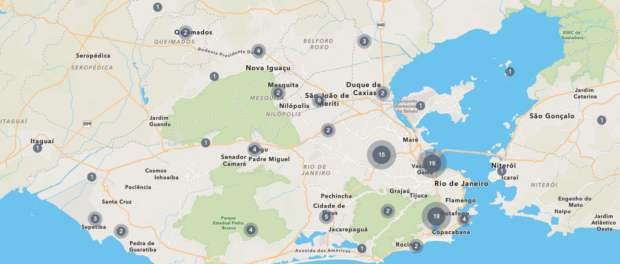
Reporting from Rio on Watch: New Sustainable Favela Network Map Makes Palpable The Sheer Diversity of Favela Solutions
Click here to check out the Mapa da Rede Favela Sustentável!
 Guillermo Douglass-Jaimes, PhD